Tanker Unloading Pump Kit for Ethanol
Urgent Customer Request for an Ethanol Tanker Unloading Kit
A UK customer contacted us with an urgent requirement: they needed a solution to unload a 24,000-litre tanker of ethanol that was due to arrive within two days, so that the product could be dispensed into IBCs.
The ethanol was intended for the manufacture of hand sanitizer, and the customer had no way to offload the cargo in the current situation. Supplying an ATEX-rated pump kit for container emptying in less than 24 hours is something most companies would find difficult, if not impossible.
Tanker unloading requires careful consideration because the liquids involved often have low boiling points and high vapour pressures. If the pump is incorrectly selected, these properties can easily damage internal pump parts through cavitation or cause the unit to destroy itself.
Ethanol is a clear, colourless liquid belonging to a group known as Volatile Organic Compounds (VOCs). These are fluids with a boiling point below 250°C and include other liquids such as alcohol, petrol, kerosene, formaldehyde, methyl chloride, benzene, and xylene.
Such liquids have a high vapour pressure, meaning that large numbers of molecules can evaporate from the liquid into the surrounding air, creating flammable vapours without heating and often at room temperature.
Because ethanol is highly flammable, care must be taken, especially given its low flash point. The flash point is the lowest temperature at which a liquid can form a flammable mixture in air around the liquid surface. For ethanol, this is only 13°C, so it can be easily ignited.
North Ridge Pumps Selects an ATEX Horizontal Magnetic Drive Pump
Our normal selection for this type of duty would be a side channel pump, which is well known for its ability to handle problematic liquids with low boiling points, low tank levels, or containers that require complete emptying.
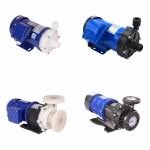
However, given the time constraints, we selected an ATEX horizontal magnetic drive pump. This pump design is completely sealless, meaning there is zero possibility of leakage from the pump head because there is no shaft seal connecting the drive and motor shaft. Two magnets drive the unit, keeping the pump head free from seals that can wear, degrade, and leak over time.
The design also means that the internal bearings are lubricated by the fluid being pumped. It was therefore important that the pump did not operate without fluid—a condition known as dry running.
Because the unit was being used to empty a tanker, it could at times handle only vapour, which could lead to seal or bearing damage if managed incorrectly. To prevent bearing damage, we supplied a digital load monitor. This device is calibrated on site to ensure the pump is protected at all times, especially when reaching the end of a pumping load, when the unit may handle a mixture of vapour and fluid that is insufficient for bearing lubrication.
Air and vapour can be drawn into a pump when low levels of fluid are present in a tank—a condition known as vortexing.
The digital load monitor ensures that the pump is stopped before dry running occurs—within 0.2 seconds—giving the fluid time to settle. The pump can then be restarted to complete tanker emptying until the load monitor is activated once more, indicating that there is no more fluid to extract.
The customer also required ATEX suction and delivery hoses to connect to the tanker, plus a discharge valve to control IBC filling. We supplied the ATEX suction hose with a VK80 tanker coupling, and the delivery hose complete with a discharge valve to control dispensing.
The hose was supplied the same day, and the pump by 09:30 the following day, enabling the customer to discharge the tanker safely without delay.